




 HOME
HOME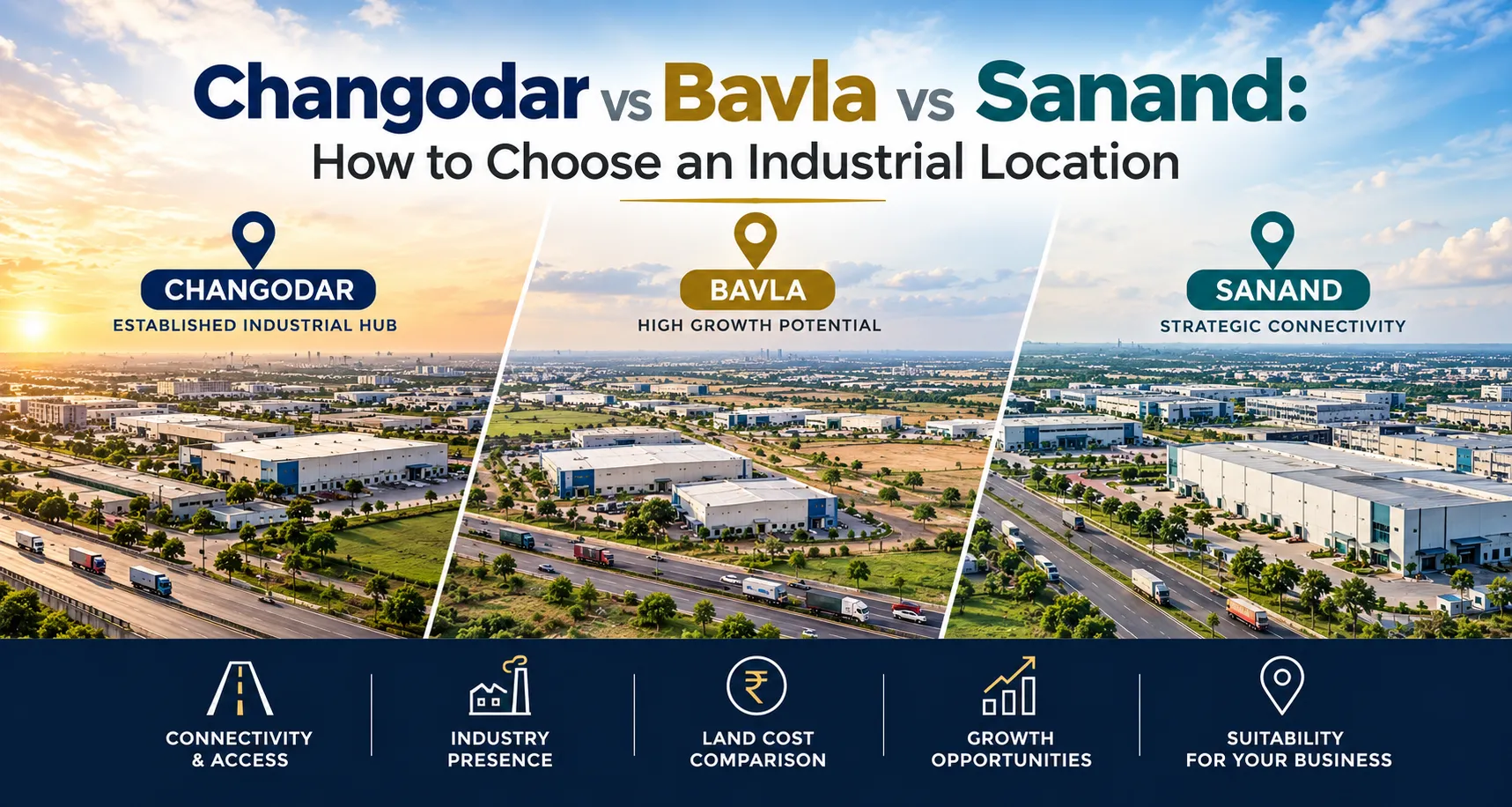
Choosing an industrial location affects much more than your property purchase. It influences delivery schedules, employee travel, supplier access and the space available for future growth. When comparing Changodar vs Bavla vs Sanand , the most useful question is: which location supports your business’s daily operations?
A manufacturer, warehouse operator and distribution business may evaluate the same locations differently. This guide explains how to compare transport routes, workforce access, supplier proximity and expansion needs, with reference to Sun Industrial Park’s position on the Sarkhej–Bavla corridor.
Start With Your Business Requirements
Before comparing areas, prepare a brief covering your production process, customer locations, supplier network and expected vehicle movement.
Identify your essential requirements:
- Plot area and usable building space.
- Machinery and storage requirements.
- Electricity and water needs.
- Daily truck movements and loading arrangements.
- Workforce size and commuting needs.
- Space required for future expansion.
Separate essential requirements from preferences. A business receiving large vehicles daily may prioritise approach-road access, while another may place greater importance on proximity to a key customer.
This prevents a location’s reputation or an attractive quotation from outweighing practical suitability.
Changodar vs Bavla vs Sanand: A Comparison Framework
Use the following questions to assess individual properties rather than assuming every plot within an area offers the same advantages.
|
Factor |
Changodar |
Bavla |
Sanand |
|
Transport routes |
Test routes to your Ahmedabad-side customers and suppliers |
Test access along the Sarkhej–Bavla corridor and onward delivery routes |
Test routes to your manufacturing customers and supply partners |
|
Workforce access |
Check actual employee commuting options |
Assess travel arrangements for your planned workforce |
Compare commuting routes with your recruitment catchment |
|
Supplier proximity |
Map relevant suppliers around the shortlisted site |
Calculate delivery distances from your existing vendors |
Check access to vendors serving your specific production process |
|
Expansion needs |
Verify additional space and building flexibility |
Compare available plot layouts and development conditions |
Assess future capacity against your business requirements |
The strongest choice is the site that performs well on your highest-priority factors.
1. Compare Actual Transport Routes
Transport suitability depends on where goods originate and where they need to go. A plot close to a highway can still have an inconvenient entrance, restricted turning space or a difficult final approach.
For each shortlisted property, map three journeys: inbound raw materials, outbound finished goods and employee travel.
Record journey times during normal working hours. Ask transport partners to assess whether their vehicles can approach, enter and turn comfortably.
When reviewing industrial plots in Bavla, examine both the main-road connection and the route from the highway to the plot. Apply the same check to Changodar and Sanand properties.
Sun Industrial Park’s website places the project on NH-47, Sarkhej–Bavla Road, at Sari Patiya, opposite Gallops Industrial Park. Its location page lists Changodar, Bavla and Sanand as nearby destinations. These details provide a starting point for route planning; confirm the journeys relevant to your operation during a visit.
2. Evaluate Workforce Access
An industrial location should be practical for the people who will operate your business.
Start by identifying where your existing employees live or where you expect to recruit. Check public transport options, pickup points and the need for company-arranged transport.
Consider shift timings as well as daytime access. A route that works during office hours may be less convenient for early or late shifts.
Ask:
- Can employees reach the site reliably?
- What would staff transport cost each month?
- Is the approach suitable for two-wheelers?
- Are basic food and daily-use facilities accessible?
- Would relocation affect employee retention?
Avoid assuming that proximity to an industrial area guarantees access to suitably skilled workers. Recruitment requirements differ between engineering, packaging, warehousing and other operations.
3. Measure Supplier and Customer Proximity
Supplier proximity matters when your business depends on frequent deliveries, machine servicing or urgent replacement parts.
List your most important vendors, including raw-material suppliers, maintenance contractors, packaging providers and transport operators. Calculate their travel distance to each shortlisted site.
For businesses evaluating factory plots near Sanand, check whether the specific location improves access to actual customers and vendors. The area name alone does not establish an operational advantage.
Compare delivery frequency too. A modest additional distance may be manageable for weekly deliveries but costly when several trips are required each day.
Ask vendors about service coverage and response times before deciding. Reliable support can be as valuable as a shorter route.
4. Plan for Expansion Before Buying
Your current space requirement is only part of the decision. Consider how production, storage and dispatch needs could change over the next few years.
Review plot dimensions, frontage and the proposed building layout. Determine whether additional machinery, loading space or storage could fit without disrupting existing operations.
Ask about adjacent availability, but avoid treating future purchases as guaranteed.
Sun Industrial Park’s website states that Phase 1 is operational and Phase 2 offers additional plots for manufacturing, warehousing and logistics. Buyers can request the current layout and assess available options against their expansion plans. www.sunindustrialpark.com
A larger plot is useful only when its shape, permitted development and infrastructure suit the business.
5. Check Infrastructure and Total Costs
In the Changodar vs Bavla vs Sanand comparison, evaluate individual properties using the same infrastructure checklist.
Confirm power capacity, water arrangements, drainage, road access, security and maintenance responsibilities. Request specifications relevant to the shortlisted plot.
Sun Industrial Park lists RCC roads, water supply, street lighting, parking, security and other infrastructure on its features page. Inspect these facilities and clarify their capacity and availability for your intended operation.
Compare total costs, including land, construction, utility connections, staff transport and recurring maintenance. Have relevant professionals review documents and technical suitability before commitment.
Choose the Location That Fits Your Operation
There is no universal winner between Changodar, Bavla and Sanand. Score shortlisted properties against transport, workforce, suppliers, infrastructure and expansion, giving the greatest weight to your essential requirements.
If you are exploring industrial plots in Bavla or factory plots near Sanand, consider Sun Industrial Park as part of your comparison. Share your business activity, plot requirement and operational priorities, then arrange a site visit to assess suitable available options.