




 HOME
HOME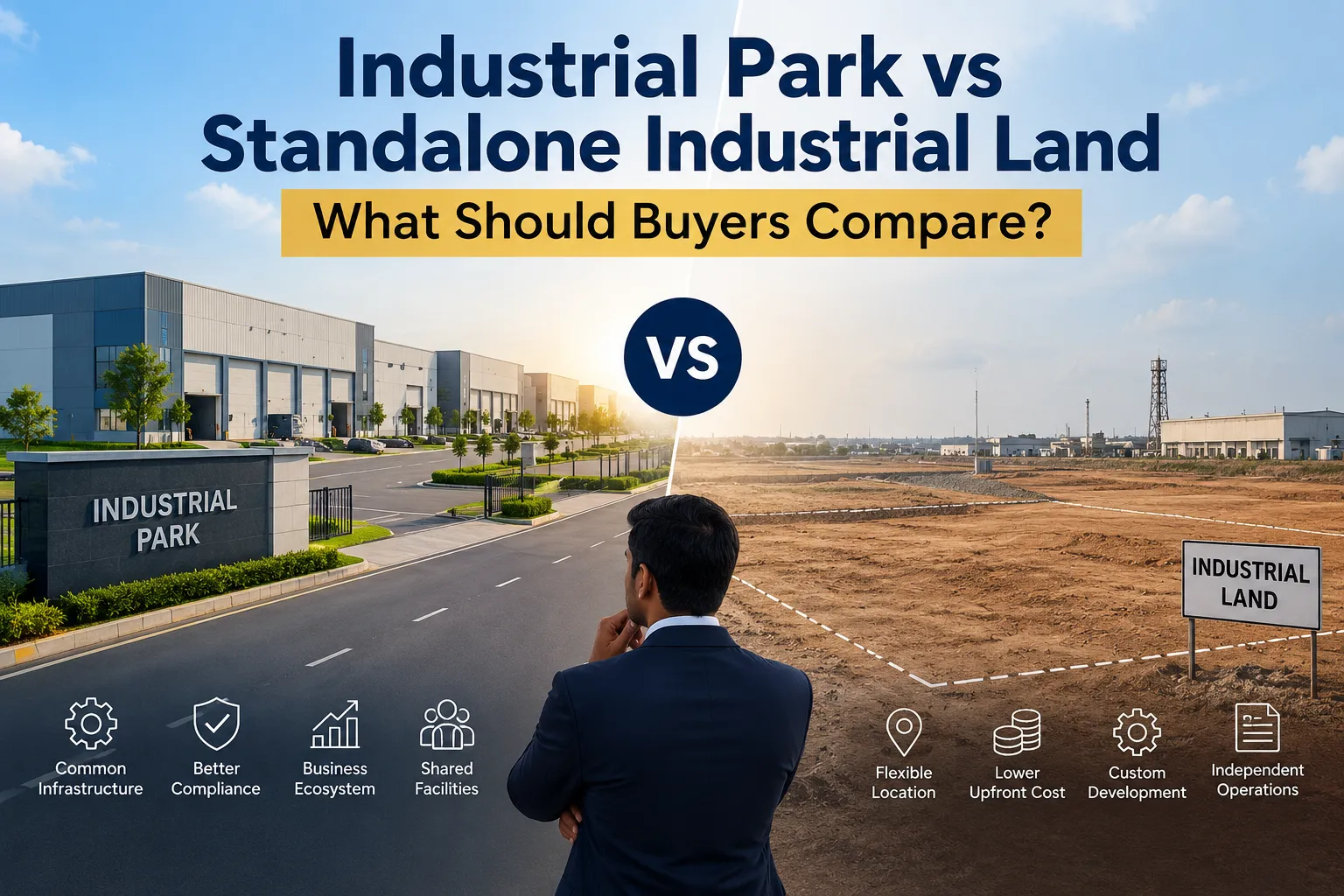
Choosing between an industrial park and a separate land parcel affects how you establish and manage your business premises. Beyond the purchase price, you need to understand infrastructure responsibilities, development requirements, maintenance arrangements and the work needed before operations can begin.
When comparing industrial park vs standalone industrial land, neither option is automatically better. The right choice depends on your business activity, technical requirements, budget and ability to coordinate development.
For businesses exploring industrial land near Ahmedabad, this guide provides a practical framework, with reference to Sun Industrial Park’s published project information.
What Is the Difference?
An industrial park generally contains multiple industrial plots within a planned development. It may provide shared roads, utility infrastructure, drainage, security and management services. The exact facilities and responsibilities depend on the project and purchase agreement.
Standalone industrial land is a separate parcel where the buyer may need to arrange more of the infrastructure and development independently. However, some standalone properties already have road access, utility connections or buildings.
Similarly, developed industrial plots do not necessarily include a completed factory, warehouse or every connection your operation requires. Always establish what “developed” means for the specific property.
|
Factor |
Industrial park |
Standalone industrial land |
|
Infrastructure |
May include shared project facilities |
Existing facilities vary by parcel |
|
Management |
May have a common management arrangement |
Often requires buyer coordination |
|
Development |
Subject to applicable rules and project terms |
Subject to applicable rules and site conditions |
|
Maintenance |
Shared and individual responsibilities must be defined |
Buyer may manage more services directly |
|
Setup cost |
Land price plus remaining development and charges |
Land price plus required infrastructure and development |
1. Compare Infrastructure Responsibilities
Start by identifying what exists, what is usable and what you must arrange.
In an industrial park, ask whether internal roads, drainage, water infrastructure and electricity infrastructure serve your shortlisted plot. Confirm capacity, connection arrangements and any additional charges.
Sun Industrial Park’s features page lists RCC roads, water supply, power infrastructure, stormwater drainage and street lighting. Buyers should verify the facilities serving their selected plot and request details relevant to their intended operation. https://www.sunindustrialpark.com/features
For standalone land, investigate road access, utility availability and drainage arrangements separately. A nearby power line or water source does not establish that a suitable connection is available.
Prepare a responsibility list showing which tasks belong to the seller, park management, utility provider and buyer.
2. Understand Management and Maintenance
Shared management can help coordinate common facilities, but the arrangement needs clear terms.
Ask an industrial park’s management team who maintains roads, drainage, lighting, security and common areas. Request information about charges, service responsibilities and how businesses report problems.
Sun Industrial Park lists security, CCTV surveillance, parking and administrative facilities. Confirm how these services operate and whether their costs are included or charged separately.
With standalone land, you may need to organise boundary security, access maintenance and site services yourself. Where roads or facilities are shared with neighbouring properties, establish access rights and maintenance responsibilities.
Consider whether your team has the time and expertise to manage these arrangements alongside business operations.
3. Calculate the Complete Setup Requirement
A useful industrial park vs standalone industrial land comparison should cover the complete route from purchase to an operational facility.
For both options, assess:
- Document review and transaction costs.
- Surveying and site preparation.
- Building design and construction.
- Machinery foundations and internal services.
- Utility connections and capacity requirements.
- Loading areas, parking and vehicle circulation.
- Applicable approvals and professional fees.
Developed industrial plots may reduce certain external infrastructure tasks. However, buyers still need to confirm construction requirements, internal installations and permissions for their business.
For standalone land, identify any additional work needed to make access and services suitable. Obtain estimates before assuming the lower land quotation produces a lower overall cost.
4. Check Plot Suitability and Development Conditions
Compare usable space rather than area alone.
Review frontage, depth, boundaries and the position of the access road. Ask an architect or industrial planning professional to test a layout showing production, storage, offices, loading and parking.
In an industrial park, request project-specific development conditions, if any. Check whether they suit your proposed building, vehicle movement and operating requirements.
For standalone land, have relevant professionals assess site constraints and applicable development rules. Independent ownership does not remove regulatory requirements or guarantee unrestricted use.
For either option, verify that your intended activity is suitable before committing.
5. Review Documents and Access Rights
When buying industrial land near Ahmedabad, obtain documents relating to the specific parcel.
Have an independent property lawyer examine ownership records, title history, encumbrances, access rights, relevant land-use permissions and agreement terms.
Sun Industrial Park describes its land as NA-approved, title-clear and supported by NOC and plan approval. These descriptions should guide your document requests; they do not replace an independent review of the underlying records.
Ask which permissions cover the project and which approvals your proposed business must obtain separately. For standalone land, confirm that the legal access arrangements match the road used during your inspection.
6. Assess Setup Timing and Expansion
Ask what must happen before construction and operations can start. Build a realistic schedule around possession, design, approvals, utility connections and construction.
Sun Industrial Park’s website states that Phase 1 is operational and Phase 2 offers plots for manufacturing, warehousing and logistics. Request current plot availability, infrastructure status and written possession terms.
For standalone land, establish the sequence and responsibility for any infrastructure work.
Consider expansion within the chosen plot. Do not assume neighbouring land will remain available or that future purchases can be completed on the same terms.
Choose Based on Your Business’s Priorities
An industrial park may suit buyers who value planned infrastructure and shared management. Standalone land may suit businesses prepared to coordinate more development independently or requiring a particular site configuration.
Compare both using verified documents, technical assessments, written quotations and clearly assigned responsibilities.
Explore Sun Industrial Park if developed industrial plots fit your requirements. Share your business activity, space needs and utility demand, then arrange a site visit to evaluate suitable available options and the remaining setup work.