




 HOME
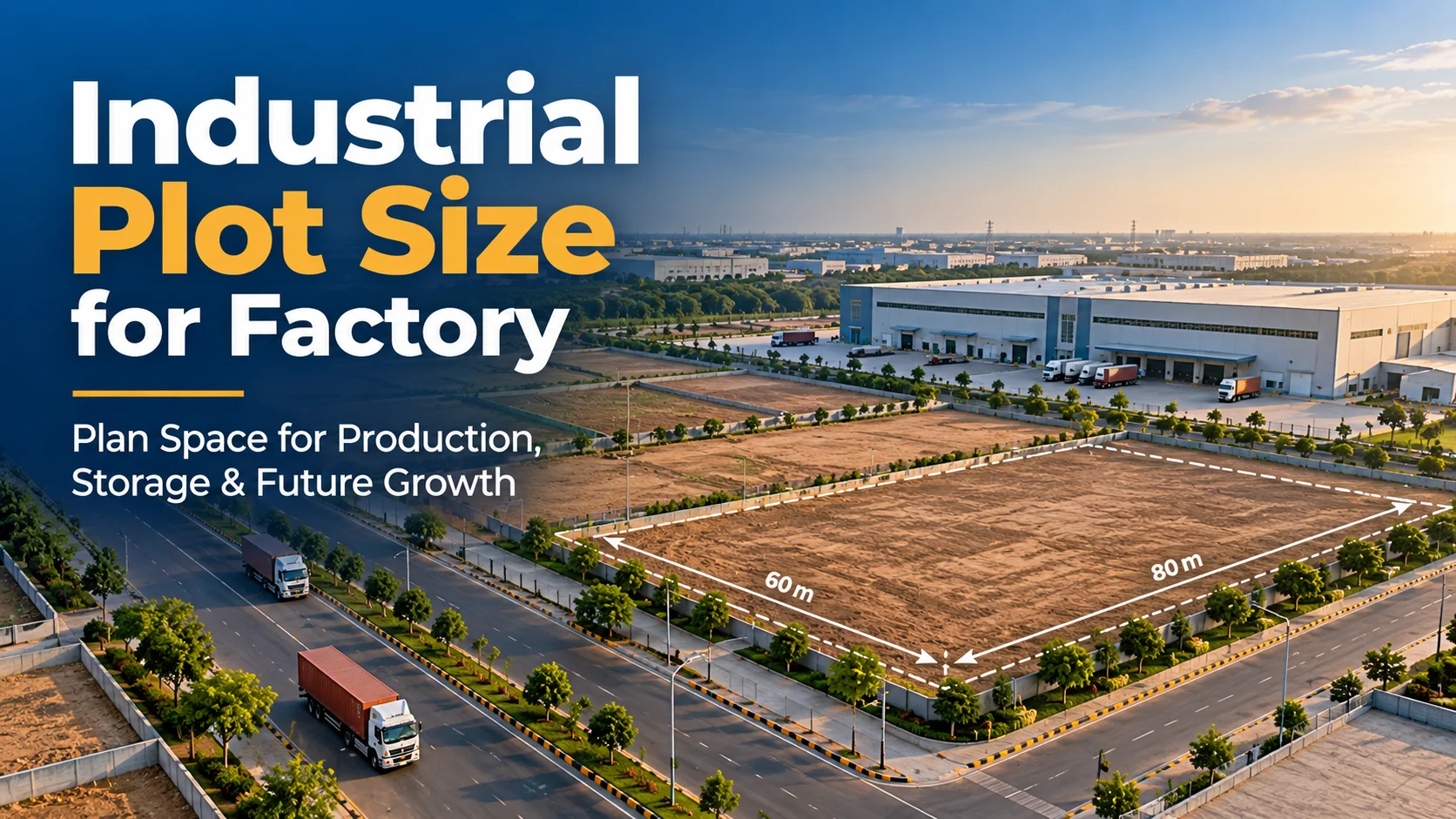
Your machines fit inside the proposed shed. But where will raw materials arrive, finished goods wait and delivery trucks turn? These questions can reveal whether a plot will support your factory comfortably or create daily operational difficulties.
Choosing the right industrial plot size for factory operations means planning beyond the production floor. Storage, circulation, parking, utilities and future expansion all need space.
For businesses exploring industrial plots near Ahmedabad, the best starting point is a practical layout based on how the factory will operate. Here is how to build that requirement before shortlisting land.
1. Start With Your Production Process
Begin by mapping the journey from incoming materials to finished products. List every major activity: unloading, inspection, processing, assembly, quality checks, packing and dispatch.
Next, record each machine’s dimensions. Include the working space around it, operator positions, maintenance access and material handling routes. A machine’s footprint alone does not represent its total space requirement.
Consider these questions:
- Will production follow a straight line or separate workstations?
- Do products move manually, by trolley or by forklift?
- Will equipment need foundations, ventilation or overhead lifting?
- Can maintenance teams access machinery without blocking production?
A compact assembly unit and a fabrication factory may have similar output targets but very different space needs. Your production process should guide your factory plot size.
Read More: Industrial Park vs Standalone Industrial Land: What Should Buyers Compare?
2. Calculate Storage from Inventory Needs
Storage requirements depend on how much stock you hold and how quickly it moves.
Estimate the space needed for raw materials, work in progress, finished goods, packaging, rejected items and returns. Keep incoming and outgoing goods organised so they do not spill into production aisles.
For example, a business receiving materials weekly may need more storage than one receiving smaller daily deliveries. Seasonal demand can also increase inventory beyond normal levels.
Vertical racking may reduce the floor area needed, but its suitability depends on product weight, building height, handling equipment and fire protection requirements.
Plan storage around realistic peak inventory rather than an unusually quiet month.
3. Allow Space for Circulation and Loading
A plot can look spacious on paper and still be difficult to operate if vehicles cannot move conveniently.
Check the largest vehicle expected at your factory. A small delivery van and a long goods vehicle need different gate openings, turning arrangements and unloading areas.
Your layout should account for:
- Entry and exit movements.
- Loading and unloading positions.
- Vehicle waiting space within the premises.
- Forklift and trolley routes.
- Pedestrian access separated from vehicle movement where practical.
Do not assume that the industrial park’s internal road can serve as your loading yard. Assess movement within your own plot.
Plot proportions matter here. Two plots with equal area can offer different usability because of frontage, depth, gate position and building placement.
4. Include Parking, Utilities and Staff Facilities
Parking often becomes an afterthought until employee vehicles begin blocking goods movement.
Estimate two-wheeler, car and visitor parking based on expected staffing and shift patterns. Consider whether incoming and outgoing shifts overlap.
Also identify space for offices, toilets, changing areas, drinking water and other staff facilities appropriate to your operation.
Utilities may require dedicated areas for electrical equipment, compressors, backup power, water storage or waste handling. Some processes may also need treatment systems or additional service installations.
The industrial plot size for factory planning should accommodate these functions from the beginning. Their final position should support safe access and straightforward maintenance.
5. Reserve Usable Space for Future Expansion
Buying only enough land for today can make tomorrow’s expansion difficult. However, purchasing extra area without a layout does not automatically solve the problem.
Think about how your business could grow over the next three to five years. Would you add another production line, increase storage or introduce larger machinery?
Identify where that growth would happen. Expansion space should connect logically to the existing production flow without obstructing loading areas or access routes.
Practical planning insight: Trace one incoming delivery and one outgoing shipment across your proposed layout. Then repeat the exercise with an additional production line. This can expose bottlenecks that a simple area calculation misses.
6. Turn Your Requirements into a Plot Estimate
Prepare an area schedule before comparing properties. The following example illustrates the method; it is not a prescribed factory standard.
|
Space requirement |
Illustrative area |
|
Production and machine working space |
8,000 sq. ft. |
|
Storage and packing |
3,000 sq. ft. |
|
Office, staff facilities and indoor utilities |
1,000 sq. ft. |
|
Initial covered space requirement |
12,000 sq. ft. |
The plot must also accommodate outdoor loading, circulation, parking, applicable open spaces and planned expansion.
For illustration, if the permitted ground coverage were 50%, a 12,000 sq. ft. ground-floor footprint would require at least 24,000 sq. ft. of land on coverage alone. That equals approximately 2,667 sq. yd.
This percentage is hypothetical. Actual development controls, setbacks, access requirements and site conditions must be checked for the specific property. A larger plot may be necessary after testing the complete layout. Avoid counting the same area twice where circulation or open-space functions overlap.
7. Compare Suitable Industrial Plots Near Ahmedabad
Once your area schedule is ready, compare plots by dimensions and operational suitability.
Sun Industrial Park’s website identifies its location on Sarkhej–Bavla Road, NH-47, and describes Phase 2 plots in a range of sizes. It also lists RCC roads, power and water infrastructure, drainage, street lighting and round-the-clock security. Confirm the services and capacities applicable to your shortlisted plot.
Request the latest layout and plot dimensions. Share your proposed activity, machinery requirements, vehicle types and expansion plans with the project team, then have your architect or industrial planner test the fit.
Read More: Warehouse Plots Near Changodar: What to Check Before Buying
Frequently Asked Questions
Is there one ideal factory plot size?
No. The appropriate size depends on production, inventory, vehicle movement, utilities, development controls and expansion requirements.
Can a multistorey building reduce land requirements?
Sometimes. However, machinery loads, material movement and process requirements may make certain activities more suitable for ground-floor operation.
What should I prepare before a site visit?
Bring a machinery list, approximate area schedule, expected vehicle sizes, utility requirements and a basic process flow.
Choose Space That Supports Daily Operations
The right industrial plot size for factory operations should support efficient production today and sensible growth tomorrow. Start with your workflow, test the layout and verify plot-specific requirements before committing.
Contact Sun Industrial Park to request the latest layout and arrange a site visit to assess options against your factory’s requirements.